
The Light in the Back Pew |
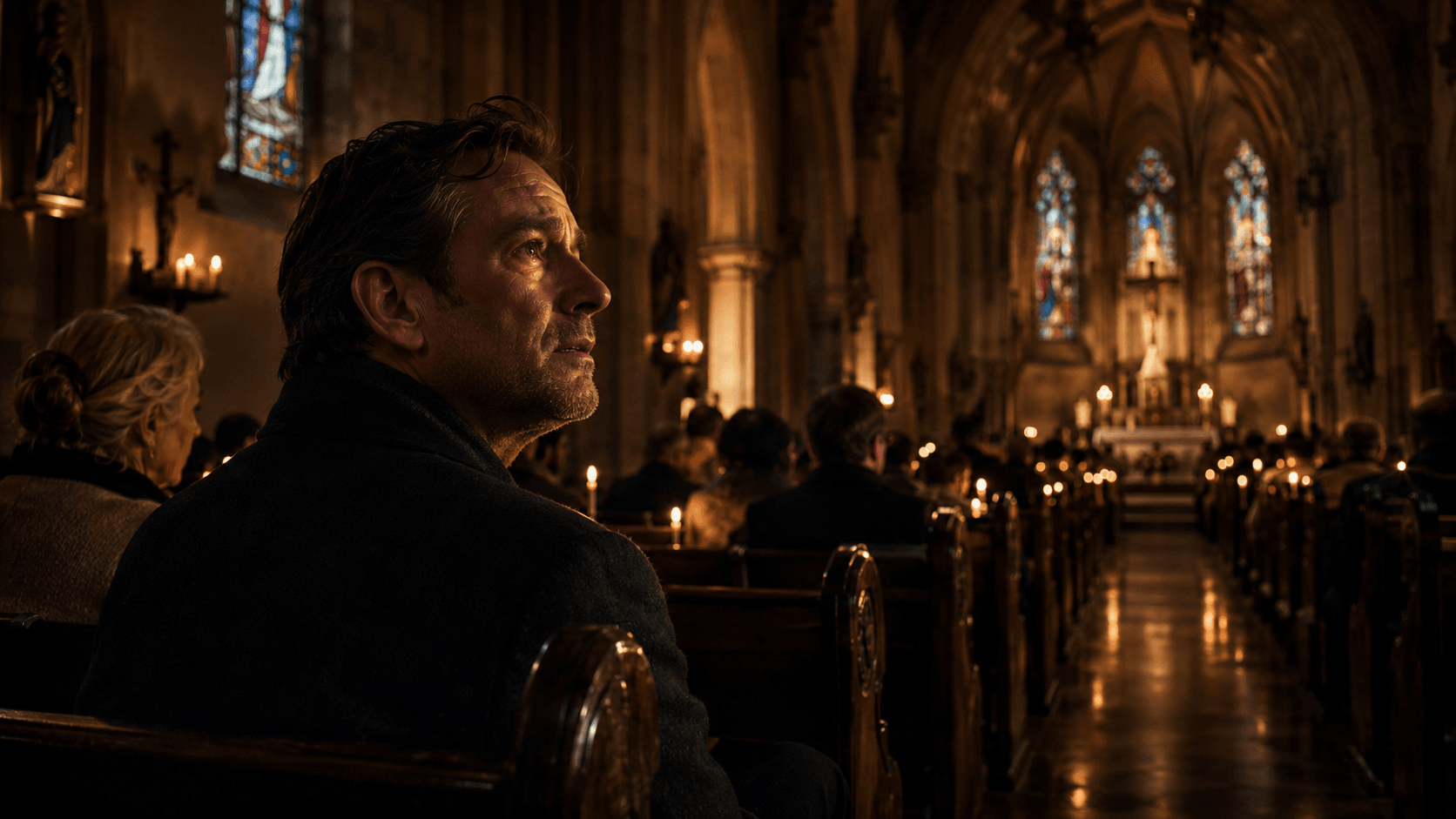
For twenty-three years, Daniel Mercer had avoided churches.
He did not cross the street when he passed one. He did not sneer at the bells. He simply kept moving, as though churches belonged to another country he had once visited and had no intention of returning to.
He had been raised Catholic in a small parish where everyone knew his family. His mother sang in the choir. His father sat near the aisle and knelt so heavily that the wooden pew groaned beneath him. Daniel had served as an altar boy, learned the prayers, memorized the responses, and believed—at least as a boy—that heaven was close enough to touch.
Then, during his final year of college, his younger sister became sick.
Daniel prayed with a desperation that frightened him. He promised God everything: his career, his plans, his future. He sat beside her hospital bed with a rosary wrapped around his hand and begged for a miracle.
She died three months later.
After the funeral, people told him she was in a better place. They told him God had a plan. They told him to trust.
Daniel did not trust.
He left the Church quietly. At first, he stopped going to Mass. Then he stopped praying. Eventually, he stopped calling himself Catholic at all.
Years passed. He built a successful career in architecture, married, divorced, and learned how to keep most conversations safely on the surface. He told himself he was free of the old questions.
But the questions were not gone. They had only grown quieter.
One November evening, Daniel received a phone call from his mother’s neighbor.
His mother had fallen.
By the time he reached the hospital, she was awake and embarrassed, insisting that everyone was overreacting. The doctor said she would recover, but she could not live alone for a while.
So Daniel returned to his childhood home.
The house seemed smaller than he remembered. His father’s coat still hung in the hallway, though his father had been dead for six years. A faded holy card rested beside the telephone. The kitchen clock ticked loudly through the night.
On Sunday morning, Daniel found his mother dressed for Mass.
“You’re not going,” he said. “You can barely walk.”
“I can walk with a cane.”
“You can watch it on television.”
She looked at him with the patient stubbornness he remembered from childhood.
“Then take me.”
Daniel laughed once, without humor.
“You know I don’t go to Mass.”
“I didn’t ask you to believe,” she said. “I asked you to drive.”
The church had changed very little.
The same stone steps. The same brass handles. The same statue of Mary near the entrance, her face tilted downward with an expression Daniel had once mistaken for sadness.
He helped his mother inside and chose a place near the back, where he could leave unnoticed.
The smell reached him first: wax, incense, old wood, winter coats damp from the cold.
Then the organ began.
Something inside him tightened.
He remembered standing beside his father. He remembered his sister whispering the wrong words to make him laugh. He remembered believing that life, however painful, was held by something larger than death.
He pushed the memories away.
During the readings, Daniel stared at the stained-glass windows. During the homily, he studied a crack in the floor. When the congregation rose to recite the Creed, he remained silent.
At Communion, his mother stepped into the aisle.
Daniel stayed seated.
One by one, people moved past him toward the altar. An elderly man leaning on his son. A young mother holding a sleeping child. A teenager with dyed blue hair. A businessman still checking his phone before slipping it into his pocket.
They did not look holy.
They looked tired.
That unsettled him more than anything.
He had spent years imagining the Church as a room full of people who possessed an answer he had been denied. But as he watched them walk forward, he saw no triumph in their faces. Only hunger.
His mother returned and knelt beside him.
Daniel looked toward the sanctuary.
He did not feel forgiven. He did not feel converted. He felt angry.
But for the first time in years, he allowed himself to admit that his anger was still directed at Someone.
That afternoon, while his mother slept, Daniel found an old box in the closet. Inside were photographs, birthday cards, and his sister’s rosary.
The beads were pale blue.
He held them for a long time.
Then he said aloud, “I don’t know what I believe.”
The room remained silent.
It was not a miracle.
But it was a prayer.
The following Sunday, he took his mother to Mass again.
And the Sunday after that.
He always sat in the back. He never received Communion. He spoke to no one. Still, he returned.
Weeks later, the pastor found him alone after Mass.
“You’re Daniel Mercer,” the priest said.
Daniel looked up. “Do I know you?”
“No. But your mother talks about you.”
“I’m sure she does.”
The priest smiled. “She says you’re angry with God.”
Daniel expected a correction, perhaps a lecture about reverence.
Instead, the priest sat beside him.
“So am I, sometimes,” he said.
Daniel studied his face.
“You’re allowed to say that?”
“You just did.”
They sat in silence.
Then Daniel told him about his sister.
He told him about the rosary in the hospital, the promises, the funeral, and the years afterward. The words came slowly at first, then all at once. When he finished, the church was nearly dark.
The priest did not explain why she had died.
He did not tell Daniel that everything happened for a reason.
He said only, “You thought faith meant God would keep you from suffering.”
Daniel stared ahead.
“Yes.”
“And when He didn’t, you believed He had abandoned you.”
“Yes.”
The priest folded his hands.
“What if faith is not the promise that you will never enter the darkness?
What if it is the promise that you will never enter it alone?”
Daniel felt his throat tighten.
He wanted to argue.
Instead, he wept.
Not gracefully. Not quietly. He bent forward, covered his face, and cried with the force of a man mourning twenty-three years too late.
The priest remained beside him.
Months passed before Daniel went to confession.
He almost left twice while waiting in line. When his turn came, he sat down, looked at the screen between himself and the priest, and discovered that he could not remember how to begin.
A voice from the other side said gently, “Take your time.”
Daniel closed his eyes.
“Bless me, Father,” he whispered, “for I have sinned. It has been twenty-three years since my last confession.”
He expected shame.
What he felt instead was relief.
He spoke about anger, pride, betrayal, failed promises, and the ways he had wounded people while pretending he could not be wounded. He did not offer excuses. He had carried them too long.
When the priest pronounced the words of absolution, Daniel felt no thunder, no vision, no sudden certainty.
He felt something smaller.
A door opening.
At Easter, Daniel attended the Vigil with his mother.
The church began in darkness. A single flame entered, and from that flame another candle was lit, then another, until the sanctuary glowed with hundreds of small lights.
Daniel watched the darkness retreat.
He thought of his sister. For years, her death had been the place where his faith ended. Now, as the light spread from person to person, he began to wonder whether love could survive what the body could not.
When the time came for Communion, Daniel stepped into the aisle. His hands trembled.
He walked forward slowly, carrying grief, regret, anger, and hope together.
The priest lifted the Host.
“The Body of Christ.”
Daniel looked at it and understood that faith was not certainty.
It was not the absence of pain.
It was the courage to return.
“Amen,” he said.
And after many years away, Daniel Mercer came home. |
30 Comments
Join the conversation
This is the most honest thing I've read about what coming back to faith actually looks like — not a dramatic conversion, not thunder and lightning, just a door opening. And then you walk through it. That's it. That's all it ever is.
The detail of the businessman slipping his phone into his pocket before Communion made me laugh a little and then feel very seen. We're all just fumbling through this. That's the whole point I think.
Crying at my kitchen table on a Tuesday morning. Didn't expect that. The line about believing that life, however painful, was held by something larger than death — that's the thing I lost somewhere and I didn't realize how much I missed it until just now.
The only thing I'll push back on is that not everyone who leaves a church leaves out of grief or anger. Some of us just genuinely don't believe anymore and it wasn't a wound, it was a conclusion. This story won't speak to all leavers. But for those it fits, it's remarkable.
'The courage to return.' I've been turning that phrase over since I finished reading. It reframes everything. It's not about having certainty or having healed. It's just about returning. That's manageable. That's something I can do.
The marriage and divorce being mentioned in one sentence — just slipped in there — says so much about how Daniel sealed everything off and kept moving on the surface. That's a whole other story right there.
I've been Catholic my whole life and never left, but I have family members who did. I never fully understood what that felt like until I read this. It helps me have more compassion for where they are. That's worth a lot.
As a writer this piece is doing a lot of things very well. Restraint mostly. The author never tells you how to feel. The kitchen clock ticking loudly at night. The coat still in the hallway. Details that carry weight without explanation.
I wanted the priest to have more of a backstory honestly. He says 'so am I sometimes' — angry with God — and then we never hear anything more about that. I'm curious who he is and what he's been through.
The teenager with blue hair going up for communion is such a small detail but it did a lot of work. The Church isn't just one kind of person. That whole paragraph of people walking forward was really well constructed.
My son stopped going to Mass after his divorce and I've never pushed him. But I think I might share this with him quietly and just leave it at that. The mother in this story is my new role model.
What struck me most is that Daniel never stops being angry by the end. He carries grief and regret and anger forward to Communion together. The story doesn't ask him to pretend those things are gone. That's rare and it's right.
The confession scene. I was not prepared. He almost left twice while waiting in line. I have been that person. I think a lot of people have been that person and never admitted it.
Not for me personally — I left religion a long time ago and I'm at peace with that. But I can see why this resonates and I respect the honesty of it. The anger parts especially feel earned.
I keep thinking about Daniel holding his sister's pale blue rosary and saying out loud 'I don't know what I believe.' The story calling that a prayer is the most quietly profound thing. It is a prayer. It really is.
Lost my daughter eight years ago. Still sitting in the back. Still not ready. But this story made me think maybe that's okay — that sitting there counts for something even when nothing feels resolved.
My mother would have done the exact same thing — shown up dressed for Mass with a cane after a fall and dared anyone to tell her no. These mothers are a specific and unstoppable type of person.
As someone who works in parish ministry, the conversation between Daniel and the priest is the most realistic portrayal of spiritual direction I've seen in a popular piece of writing in years. This is what those conversations actually look like.
I've heard that 'God has a plan' line at probably four funerals and every single time it made me want to walk out. At least this piece acknowledges how hollow it sounds to someone who is actually suffering.
The Easter Vigil scene is stunning. The image of one small flame passing light from person to person in the dark... it's the kind of thing that stays with you. Really beautiful writing.
I'm Buddhist so this isn't my tradition but grief and anger and slowly finding your way back to something bigger than yourself — that's universal. This story translated completely.
The part where he's watching people go up for communion and realizes they don't look like they have all the answers — they just look hungry — that's genuinely one of the most honest things I've read about faith in a long time.
What a priest. Just sitting down beside him instead of launching into a speech. That moment is worth more than a hundred homilies. The Church needs more people like that.
I read this out loud to my husband at breakfast and we both cried. He left the Church after his brother died and hasn't gone back in twelve years. We didn't say anything after I finished reading. We didn't have to.
Good writing but I have to be honest, 23 years of real pain doesn't resolve that neatly for most people. Feels a little too tidy at the end. Still, the middle part felt very true.
The mother saying 'I didn't ask you to believe. I asked you to drive.' — honestly that woman is a saint. Sometimes love is just asking someone to take one small step without making it into a whole thing.
I sat in the back of a church for two years before I ever went to communion again. Nobody tells you that's allowed. Nobody tells you that you can just... sit there and be angry and still show up. This got it exactly right.
The detail about Daniel's father's coat still hanging in the hallway six years after his death... that hit harder than anything else in the whole story. That's exactly how grief works in a family home.
I'll be honest, I'm not religious at all, but this still got to me. Losing someone and then being told God had a plan — I've been on the receiving end of that and it's the worst thing people say. The fact that the priest didn't say it here meant everything.
That line about faith not being the absence of darkness but the promise you never enter it alone — I've read it three times now. That's exactly what I needed to hear this week. Beautiful piece.